Certification of Management Systems
Achieve operational excellence and global recognition by certifying your management systems with CAS. We guide you through implementing and verifying compliance with a wide range of international standards.
Our Management System Certifications
Explore our core certification services designed to enhance your organization’s performance, compliance, and reputation.
Our EGAC accredited standards and technical areas are defined using IAF MD 17 and ISO 22003‑1:2022 classifications. Egypt is current at the time of issue of this scope of accreditation.
ISO 9001:2015
Quality Management
Enhance customer satisfaction and operational efficiency.
ISO 14001:2015
Environmental Management
Demonstrate your commitment to sustainability and manage environmental impact.
ISO 45001:2018
Occupational Health & Safety
Create a safer workplace and minimize risks to your employees.
ISO 22000:2018
Food Safety
Ensure the highest standards of food safety across your supply chain.
ISO 13485:2016
Medical Devices
Meet stringent regulatory requirements for medical device quality.
ISO 50001:2018
Energy Management
Optimize energy consumption, reduce costs, and improve performance.
ISO 22301:2019
Business Continuity
Ensure your organization’s resilience against disruptive incidents.
Technical Areas We Cover
We are accredited to perform audits across a wide range of industries and sectors for various standards.
ISO 9001 IAF Codes (based on IAF MD 17)
- 01: Agriculture, forestry and fishing
- 03: Food products, beverages and tobacco
- 04: Textiles and textile products
- 05: Leather and leather products
- 06: Wood and wood products
- 07: Pulp, paper and paper products
- 08: Publishing companies
- 09: Printing companies
- 14: Rubber and plastic products
- 17: Basic metals and fabricated metal products
- 18: Machinery and equipment
- 19: Electrical and optical equipment
- 23: Manufacturing not elsewhere classified
- 29: Wholesale & retail trade; Repair
- 30: Hotels and restaurants
- 32: Financial intermediation; real estate; renting
- 35: Other services
- 36: Public administration
Additional EGAC accredited standards associated with these technical areas include ISO 50001 and ISO 22301.
ISO 14001 IAF Codes (based on IAF MD 17)
- 01: Agriculture, forestry and fishing
- 03: Food products, beverages and tobacco
- 04: Textiles and textile products
- 05: Leather and leather products
- 06: Wood and wood products
- 07: Pulp, paper and paper products
- 08: Publishing companies
- 09: Printing companies
- 12: Chemicals, chemical products and fibres
- 14: Rubber and plastic products
- 17: Basic metals and fabricated metal products
- 18: Machinery and equipment
- 19: Electrical and optical equipment
- 23: Manufacturing not elsewhere classified
- 29: Wholesale & retail trade; Repair
- 30: Hotels and restaurants
- 32: Financial intermediation; real estate; renting
- 33: Information technology
- 35: Other services
- 36: Public administration
- 37: Education
ISO 45001 IAF Codes (based on IAF MD 17)
- 01: Agriculture, forestry and fishing
- 03: Food products, beverages and tobacco
- 04: Textiles and textile products
- 05: Leather and leather products
- 06: Wood and wood products
- 07: Pulp, paper and paper products
- 08: Publishing companies
- 09: Printing companies
- 14: Rubber and plastic products
- 17: Basic metals and fabricated metal products
- 18: Machinery and equipment
- 19: Electrical and optical equipment
- 23: Manufacturing not elsewhere classified
- 29: Wholesale & retail trade; Repair
- 30: Hotels and restaurants
- 32: Financial intermediation; real estate; renting
- 33: Information technology
- 35: Other services
- 36: Public administration
- 37: Education
ISO 22000 Food Chain Categories (based on ISO 22003‑1:2022)
- AI: Farming of animals for meat/milk/eggs/honey
- AII: Farming of fish and seafood
- BI: Farming – Handling of plants
- BII: Farming – Handling of grains and pulses
- BIII: Pre-process handling of plant products
- CO: Animal – Primary conversion
- CI: Processing of perishable animal products
- CII: Processing of perishable plant-based products
- CIII: Processing of perishable mixed products
- CIV: Processing of ambient stable products
- D: Feed and animal food processing
- E: Catering/food service
- FI: Retail/wholesale
- FII: Brokering/trading
- G: Transport and storage services
- H: Services
- I: Production of packaging material
- J: Production of (bio)chemicals
Your Path to Certification
Our audit process is transparent and structured to guide you at every stage, whether you are starting fresh, transferring, or renewing your certification.
Initial Audit Process
A two-stage process to verify your management system’s compliance and effectiveness.
1. Application & Planning
Submit your application, receive a proposal, and agree on the audit scope. We then select a qualified audit team and develop a detailed audit plan.
2. Stage 1 Audit: Readiness
We conduct a thorough documentation review and assess your site-specific conditions to ensure you are ready for the main audit. A report is issued with findings.
3. Stage 2 Audit: Implementation
Our team conducts an on-site or remote audit to evaluate the implementation and effectiveness of your management system against the standard.
4. Review & Decision
An independent technical reviewer assesses all audit reports. Based on their recommendation, the final certification decision is made.
5. Certification Issued
Upon a successful decision, your official certificate is issued, and you receive the certification mark to showcase your achievement.
Surveillance & Recertification
Periodic audits to ensure your management system continues to meet standards and drive improvement.
1. Notification & Planning
We notify you of your upcoming audit. You confirm the details, and we prepare the audit plan and financial offer.
2. Audit Execution
The audit team conducts the surveillance or recertification audit to assess ongoing conformity and continual improvement.
3. Reporting & Review
A detailed report is prepared and submitted for independent technical review, along with any non-conformities.
4. Decision & Maintenance
A decision is made to maintain your certification. For recertification, a new certificate is issued to begin the next 3-year cycle.
Transfer Audit Process
Seamlessly transfer your existing, valid certification from another certification body to us.
1. Application & Pre-Transfer Review
Submit your transfer application with your current certificate and audit reports. We conduct a thorough review of your certification history.
2. Planning & Agreement
We determine the audit scope, provide a financial offer, and create a plan to integrate you into our certification cycle.
3. Transfer Audit
We conduct the transfer audit, which may range from a documentation review to a full on-site audit, depending on the pre-transfer assessment.
4. Decision & New Certificate
After a successful review and decision, we accept the transfer and issue a new certificate under our accreditation.
CAS Certification Mark Use Policy and Guidelines
This policy governs the use of the CAS Certification Mark to ensure its integrity and value.
1. Purpose and Scope
This document establishes the policy and guidelines for the use of the CAS Certification Mark (“the Mark”). It applies to all organizations (“certified clients”) granted certification by CAS. The Mark is a registered trademark, and its use is legally controlled to maintain its status as a recognized symbol of a certified management system.2. General Principles of Use
- Management System Certification: The Mark signifies that a client’s management system has been audited and certified. It shall not be used in any manner that could be interpreted as denoting product, process, or service conformity.
- Business-to-Business Context: The Mark is intended for use in business-to-business (B2B) communications. It must not appear on consumer-facing materials, at the point of sale, or on final product packaging.
- Integrity and Reputation: The Mark shall not be used in a manner that would bring CAS or the certification system into disrepute or diminish public trust.
3. Visual Style and Display Guidelines
3.1 The Certification Mark
The Mark is provided in two primary versions for use on light or dark backgrounds to ensure legibility.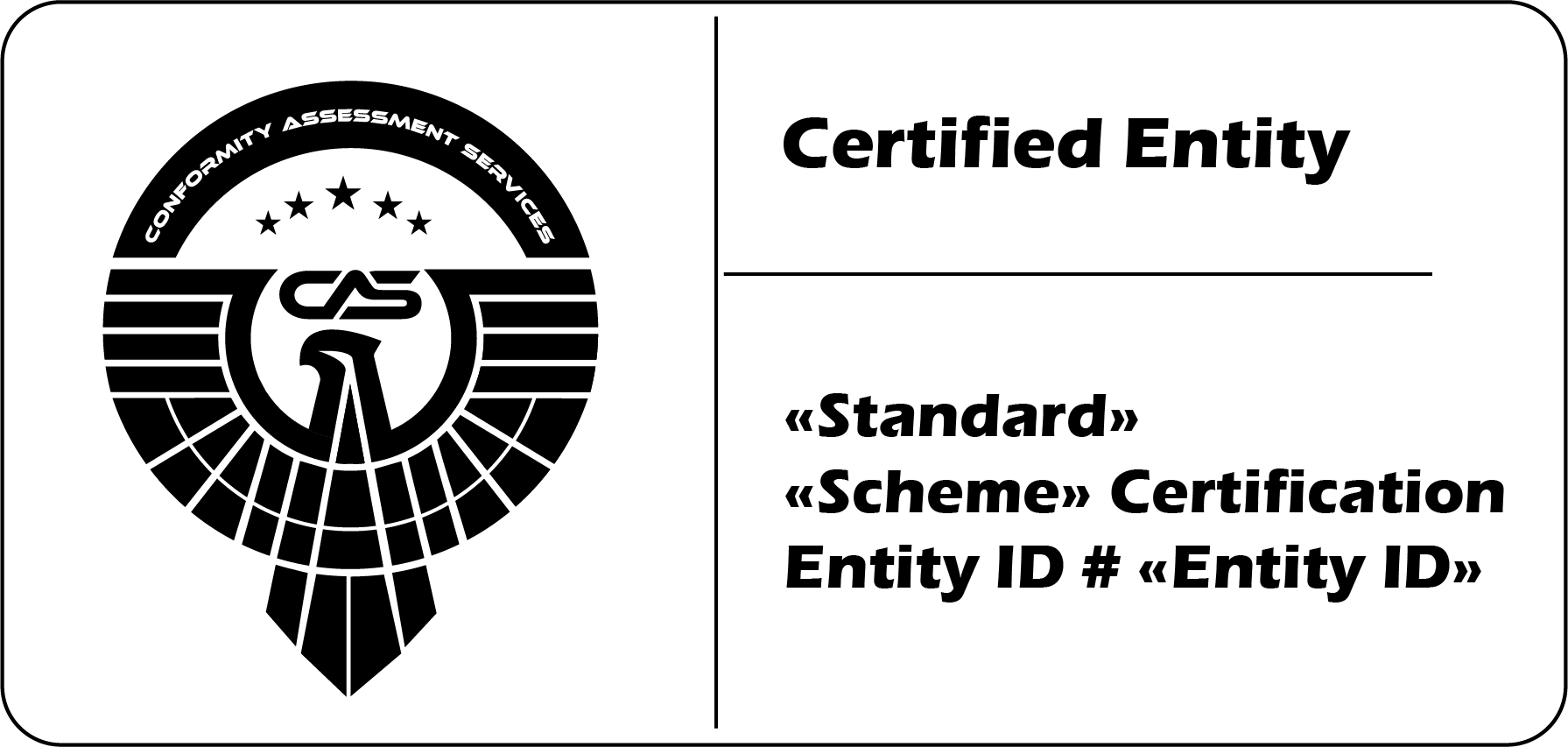
Primary Mark (for light backgrounds)
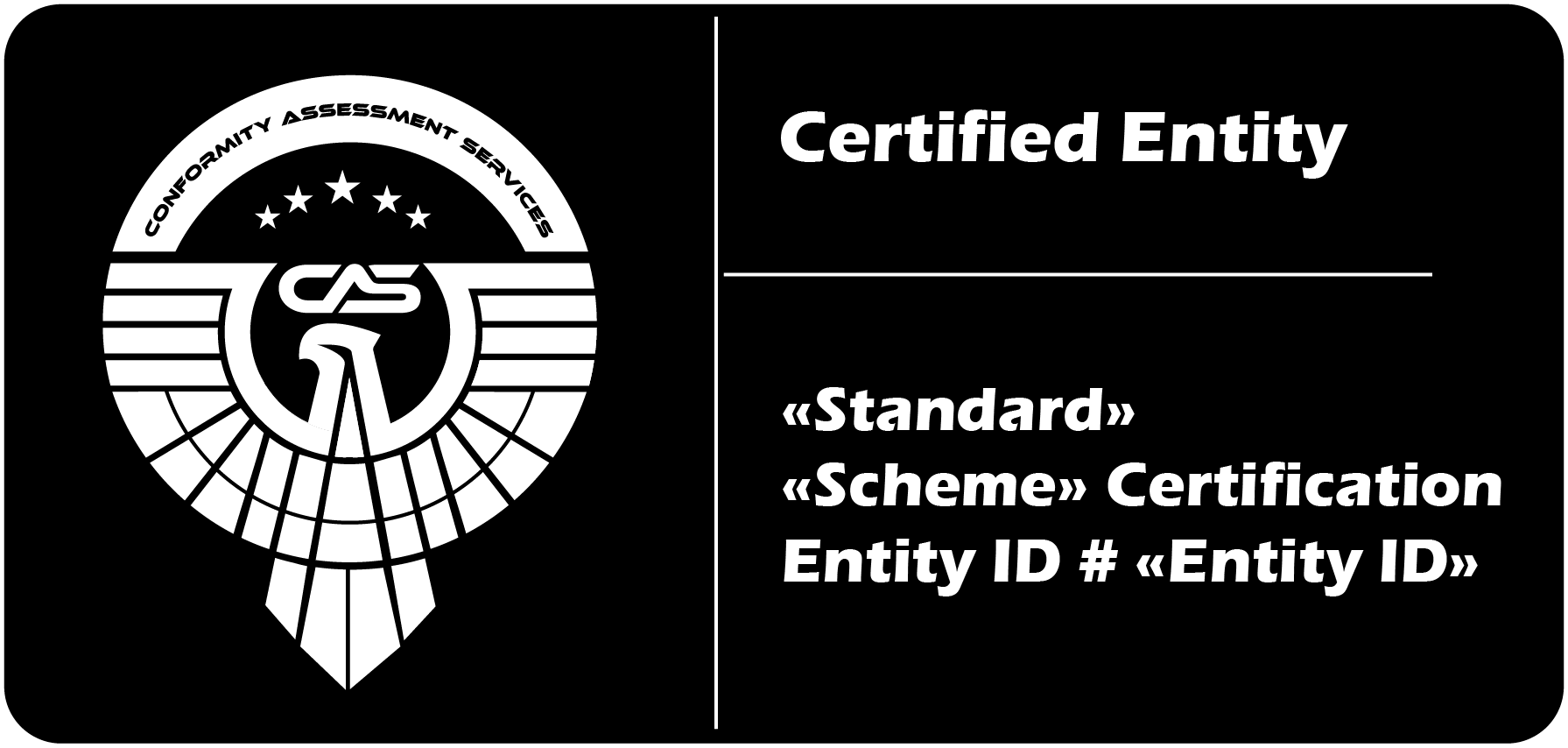
Reverse Mark (for dark backgrounds)
3.2 Sizing and Clear Space
- Minimum Width: The minimum permitted width for the Mark is 2.94 cm.
- Recommended Width: For optimal legibility, the standard width of 5.88 cm is recommended.
- Clear Space: The Mark must be surrounded by a minimum clear space equal to half its height. No other graphical elements shall intrude into this space.
3.3 Prohibited Alterations
The Mark must be reproduced in its entirety and must not be altered. This includes, but is not limited to, changing colors, distorting proportions, rotating, or removing any elements.4. Certified Client Obligations
As part of the legally enforceable certification agreement, the certified client shall:- Conform to all CAS requirements when referencing its certification status in any communication media.
- Not make or permit any misleading statement regarding its certification.
- Upon withdrawal of certification, immediately discontinue use of all advertising that contains a reference to the certification.
- Amend all advertising matter if the scope of certification has been reduced.
- Not imply that CAS certifies a product, service, or process.
- Not imply that certification applies to activities or sites outside the defined scope.
5. Permitted and Restricted Use
5.1 Permitted Use
The Mark may be used on B2B communication materials such as company websites, business presentations, letterheads, and corporate brochures.5.2 Restricted Use
- The Mark shall not be applied directly to a product or its packaging.
- The Mark shall not be used on laboratory test, calibration, or inspection reports or certificates.
6. Enforcement and Consequences of Misuse
CAS actively monitors the use of its Mark. Any incorrect reference or misleading use will be addressed. Failure to comply with this policy may result in corrective action requests, suspension or withdrawal of certification, publication of the transgression, and, if necessary, legal action.Ready to Elevate Your Standards?
Contact CAS today to discuss your certification needs and embark on your journey towards global recognition and compliance.
Get in Touch